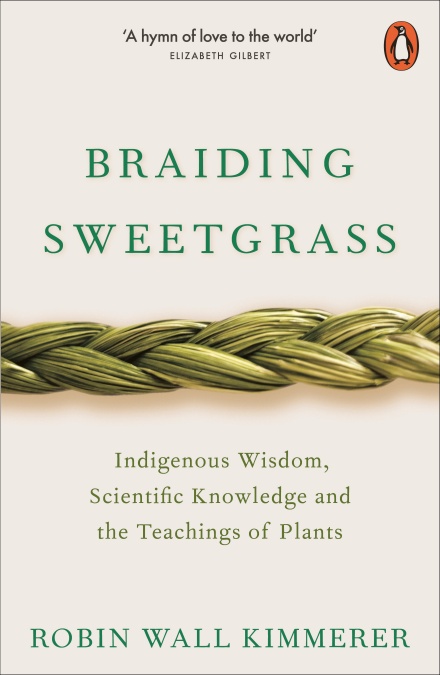
Braiding Sweetgrass

Indigenous Wisdom, Scientific Knowledge and the Teachings of Plants

400 pages

English language

Published July 29, 2020 by Penguin Books, Limited.

ISBN:
978-0-14-199195-5
Copied ISBN!

View on OpenLibrary

View on Inventaire

(3 reviews)

As a botanist, Robin Wall Kimmerer has been trained to ask questions of nature with the tools of science. As a member of the Citizen Potawatomi Nation, she embraces the notion that plants and animals are our oldest teachers. In Braiding Sweetgrass, Kimmerer brings these lenses of knowledge together to show that the awakening of a wider ecological consciousness requires the acknowledgment and celebration of our reciprocal relationship with the rest of the living world. For only when we can hear the languages of other beings are we capable of understanding the generosity of the earth, and learning to give our own gifts in return.

10 editions

Review of 'Braiding Sweetgrass' on 'Storygraph'

This book has permanently changed the way I think about the world. It made me so overwhelmed with emotions that at times I had to set down my phone and cry for a few minutes. But it is beautiful. It is poignant and important and it has given me renewed hope for a world that is increasingly terrifying. 

Radical Reframing of Nature

An obvious 5*, Kimmerer is an incredible author with a strong base of knowledge that spans across many fields. Her authorial voice is more like a guide, bringing you through her life and relationship with the world around her all while imparting important knowledge, advice, Native lore and experience, and political lessons. I do feel in parts it could have benefitted from longer chapters, but overall I found this to be a really brilliant read.

A look through the lenses of the Potawatomi

This book is a golden opportunity to get to know a bit of First Nations world view and relationship with the environment, their mythology, traditions, even nuggets of linguistics. For this reason alone I'd recommend this as a read for anyone who hasn't made such contact before.

Some parts are definitely very emotional and touching, specially regarding the sorrows brought upon the land and people subject to such destruction brought by colonizers. I can't say it was a very engaging read, though. Some chapters felt very loosely connected, some sections read like rambling or very superficial criticism, borderline naturalistic platitudes. Reminded me a lot of the idealistic Brazilian Indian Romanticism, but in a modern essayist format with a touch of scientific backing special to the author.

Subjects

  • Philosophy of nature
  • Human ecology
  • Nature, effect of human beings on
  • Human-plant relationships
  • Indian philosophy
  • Botany
  • Indians of north america, middle west
  • Indians of north america, social life and customs